
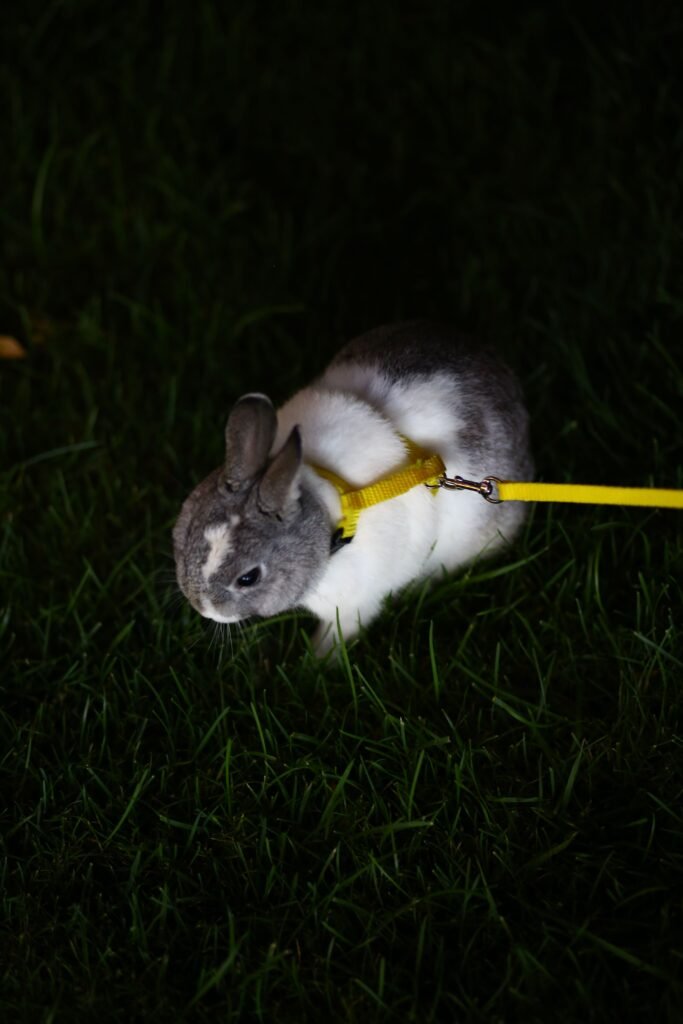
When you turn off the lights at night your bunny keeps bouncing around as if nothing has changed. It finds its water, makes its way through the space, and settles in without a hitch.
Many owners wonder how easily rabbits move in the dark. Can rabbits see in the dark, or do they just learn the layout by heart?
The truth sits somewhere in the middle. Rabbits have much stronger low-light eyesight than humans, yet they cannot see in complete darkness.
Their eyes aren’t designed for strong midday sunlight or complete darkness, but for dawn and nightfall. Knowing this enables you to create an environment where your rabbit feels secure and at ease.
This guide delves deeply into the true nature of rabbit vision. It addresses night vision, colors, their broad field of vision, blind spots, sleep, eye health, and proper house lighting.
The Short Answer: Can Rabbits See in the Dark?
First, let’s answer the primary query. Rabbits have excellent vision in low light, but they cannot see in total darkness. Consider it a spectrum. Like you, a rabbit is nearly blind in complete darkness.
However, they glow in dim, soft light. When a person is squinting and confused, a rabbit can see movement and shapes. Once you understand their nature, this makes sense. Because they are crepuscular, rabbits are suited to the dark hours of dawn and twilight.
How a Rabbit’s Eyes Work
Examine the cells of rabbits’ eyes to learn about their eyesight. Rods and cones are the two types of light-sensing cells found in the retina. Cones handle color and fine detail, while rods handle low light and motion. Compared with humans, rabbits have far more rods than cones.
Their low-light superpower is their rod-heavy design. The House Rabbit Society claims that although a rabbit’s vision is grainy and low in quality, it is nevertheless superior to a human’s in low light.
They have large eyes positioned high on their heads. Larger eyes let in more light, which is exactly what an animal that lives in low light requires.
Why Rabbits Can’t See in Total Darkness
So why does darkness still defeat them? It all boils down to the tapetum lucidum, a missing component. The layer behind the retina that resembles a mirror is called the tapetum lucidum. Owls, dogs, and cats all have it, which reflects light and gives them another chance to see.
Rabbits lack this reflective coating. Without it, their eyes cannot function in near-total darkness because they don’t have enough light. Because of this, a rabbit is not a true night animal. In complete darkness, a rabbit is as lost as you, yet an owl or cat can hunt in near-total darkness.
In a picture, a rabbit’s eyes may still glow red. The blood vessels in the eye, not any layer of night vision, are the source of the light.
A Rabbit’s Nearly 360-Degree Field of View.
Despite their lack of night vision, rabbits have a fantastic party trick. They can see nearly their entire surroundings at once. This originates from the location of their eyes. Each eye covers a vast expanse of the globe when positioned high on the sides of the head.
The result is a field of view of nearly 360 degrees. Without rotating its head, a rabbit can watch for threats in front, to the sides, and even behind.
However, it uses much of this vision with one eye at a time. They have poor close-up depth perception because both eyes see only a thin strip in front.
Nevertheless, the trade-off is worthwhile for a prey species. Determining precise distance matters far less than spotting a predator from any angle.
The Blind Spots You Should Know About
That expansive vision comes with a slight trade-off. In front of their nose, rabbits have a blind patch that is roughly ten degrees wide. They also have a blind spot beneath the chin. This explains why a rabbit may occasionally be unable to locate a reward that is placed right under its face.
Rabbits rely on their other senses to compensate. Anything too close to see is mapped out by their whiskers and keen sense of smell. This can explain a lot of rabbit behavior. Your bunny is simply filling in that blind spot when it sniffs a goodie right in front of it.
Here’s some handling advice. A rabbit may become frightened if you grasp it from immediately in front of it or from below.
Built to Detect Motion
A rabbit’s eyes detect movement more easily than minute details. This is another gift of being a prey animal. They are instantaneously drawn to even the smallest flicker at the border of their field of vision. That twitch may be a fox or a hawk in the wild.
This explains why a rabbit is so readily frightened by abrupt movements. A swift touch or a swooping item triggers their innate flee reflex. The most compassionate approach is to move quietly and carefully. It lets your motion-sensitive eyes know you’re not a danger.
What Colors Can Rabbits See?

Rabbits have a rudimentary color world, yet they are not completely colorblind. Scientists call their vision dichromatic. Simply put, they can distinguish between blue and green. Their eyes are trained to see those two hues.
The weak spot is red. Instead of seeing red as the vivid color you do, a rabbit probably perceives it as a dull gray or muddy hue. Color almost completely disappears at night. In low light, a rabbit’s world is mostly gray because rods can’t see color.
Are Rabbits Nearsighted or Farsighted?
Rabbits are farsighted for a good reason. They need to spot danger far away, not read fine print up close.
A rabbit may see a fox or hawk far away. That early warning gives it valuable time to freeze or run away.
However, their vision is blurry up close. Nearby objects and fine features appear hazy and grainy.
They smell and feel their food to make up for this. Their nose and whiskers pick up the close-up details their eyes can’t see.
The Third Eyelid and Why Rabbits Barely Blink
A third eyelid is a characteristic that humans lack. This thin, transparent membrane cleans and shields the eye as it sweeps across it.
This eyelid helps rabbits keep their eyes moist. They can even keep an eye on it as it moves across.
Because of this, rabbits seldom ever blink. A person blinks about fifteen times per minute, whereas a rabbit may blink only ten to twelve times each hour.
They also have an odd tear system. Rabbits have several tear glands, but each eye only has a small, easily clogged drain.
Do Rabbits Sleep With Their Eyes Open?
This is a truth that makes new owners uneasy. Rabbits frequently sleep with their eyes open.
It is not a health issue, but rather a survival habit. An open-eyed sleeping rabbit may respond to a predator much faster than one that has to wake up first.
Their third eyelid makes this possible. Even while sleeping with its eyes open, it keeps them wet and safe.
So how can you determine whether your bunny is sleeping? A loose, slouched torso, a motionless nose, slow breathing, and relaxed ears are all indicators.
How Your Rabbit Recognizes You

How does your bunny recognize you in light of all of this? Not by your face as you might anticipate.
A rabbit’s blurry vision makes it impossible to distinguish fine facial details. Rather, it interprets your general shape and movement.
Your voice and aroma do the rest. Rabbits are quite good at picking up familiar smells and sounds.
For this reason, they may become confused by an abrupt change. Wearing something heavy or carrying a large box can hide the shape your rabbit is used to.
Crepuscular, Not Nocturnal
It’s a common misconception that rabbits are nocturnal. Because they are crepuscular, rabbits are most active at dawn and dusk.
They thrive during those low-light hours. It’s the safest time to be out and about, and their eyes function at their finest.
It has a cunning survival motive. While day hunters like hawks need intense light, night hunters like owls struggle in complete darkness.
A rabbit is therefore safest from both at dusk. Their unique low-light eyes provide them the greatest advantage at that precise moment.
Special Cases: Albino, Baby, and Flat-Faced Rabbits
Not all rabbits have the same vision. Some groups have peculiarities of their own that are worth learning about.
This is the difference between infant, flat-faced, and albino rabbits.
Albino Rabbits
Albino rabbits appear pink or crimson because their eyes lack color. That missing pigment changes how light passes through the eye. As a result, they are particularly susceptible to strong light. Soft, steady lighting works best for them because harsh light makes them uneasy.
Like other rabbits, they can still move around in low light. To safeguard their delicate eyes, keep their area regularly and gently lit.
Baby Rabbits
Newborn rabbits’ eyes are tightly closed. Until they are about ten days old, their eyes remain closed. Their vision is still developing and very weak during those first weeks. To locate their mother, they rely nearly entirely on touch and scent.
Their vision catches up as they mature. After a few weeks, they see in the typical, dim-friendly rabbit manner.
Flat-Faced Breeds
Certain breeds, like dwarf lops and lionheads, have extremely short, flat faces. The curvature of their skull may compress the tear ducts.
As a result, they are more likely to have weepy eyes and clogged tear ducts. Owners of these breeds should visit a veterinarian as soon as possible and keep a close eye on their eyes.
Common Rabbit Eye Problems
A rabbit’s complex eyes can cause problems. Eye issues are easy to overlook because rabbits can hide illness. Here are the most common ones owners notice, along with their causes.
Weepy Eye and Blocked Tear Ducts
One of the most prevalent symptoms of rabbit eye issues is a wet, weeping eye. This happens when tears leak across the face because a tear duct is blocked.
Dental disease is the most frequent cause. Overgrown dental roots obstruct the twisted tear duct.
Wet fur, tear streaks, and a milky discharge are indicators. A veterinarian can treat the teeth that are causing the issue and flush the duct.
Cataracts
The eye’s lens becomes clouded and white when cataracts develop. Over time, they can cause blindness by blocking light. A parasite can cause them, although they are also frequently associated with aging. Fortunately, most rabbits adjust well to complete blindness.
If you see a clouded region in the eye, consult your veterinarian. They can identify underlying causes and confirm cataracts.
E. Cuniculi
The common parasite E. cuniculi is carried silently by a large number of rabbits. According to surveys, over half of rabbits kept as pets have been exposed to it.
It causes cataracts and inflammation in the eyes of certain rabbits. It may also result in head tilts, wobbling, and balance problems.
Deworming medication is administered by veterinarians over a period of many weeks. The best chance of a full recovery is provided by early therapy.
Conjunctivitis, Glaucoma, and Abscesses
There are a couple more problems on the list. Conjunctivitis, also referred to as pink eye, is characterized by redness, swelling, and a sticky discharge.
By raising intraocular pressure, glaucoma can cause swelling and discomfort in the eye. It is rare in rabbits, but it needs to be treated right away.
An abscess behind the eye may cause the eyeball to swell. This often stems from a tooth-root infection and needs to be treated by a veterinarian right away.
Can a Blind Rabbit Still Be Happy?
Rabbits handle losing their sight quite well, despite the fact that it can be terrifying. Many blind rabbits have contented, joyful lives.
Their sense of smell, hearing, and whiskers are already very important to them. As vision declines, those senses take over.
It’s critical to keep their surroundings predictable. Avoid moving the furniture and keep the floor clear of any new objects they might run into.
With a stable space and enough care, a blind rabbit can hop, play, and thrive. Their other senses are really good.
Setting Up the Right Lighting for Your Rabbit

Knowing how a rabbit sees makes it easy to properly light its house. The objective is smooth and steady rather than extreme in either direction.
Follow these few rules:
- Avoid putting them in total darkness for long periods of time.
- Avoid exposing them to harsh, strong light.
- Give them a somewhere to hide in the shade.
- Preserve the natural cycle of day and nite.
A small amount of ambient light is useful in the evening. Since rabbits seldom see red, a dim red nite light is the least disruptive to their slumber. Furthermore, avoid making abrupt movements in poorly lit areas. If you shock a rabbit that can’t see you clearly, it can get scared.
Frequently Asked Questions
Do rabbits need a night light?
No, they don’t. A dim room is easily handled by their low-light vision. A small amount of ambient light is nice but not essential in the evening.
Can rabbits see better than humans in the dark?
Yes. Because they have more rod cells, they are better able to detect movement and light in low light. They are still unable to see in total darkness, though.
Do rabbits sleep with their eyes open?
Yes, the majority of the time. They can react swiftly to hazards thanks to this survival behavior. Their third eyelid shields their eyes when they sleep.
Can rabbits see color?
Just a little. They can see blue and green, but they struggle to perceive red. By our criteria, they are somewhat but not entirely colorblind.
Why can’t my rabbit find a treat right under its nose?
In front of their faces, rabbits have a blind spot. Rather, your rabbit uses its nose and whiskers to find that reward.
Why does my rabbit move around at night?
Rabbits are most active at dawn and dusk because they are crepuscular. Activity in the evenings is completely normal.
Is it bad to keep a rabbit in a dark room?
It is okay for a room to be naturally dark. However, prolonged periods of total darkness might be distressing because they still need some light to feel oriented.
Conclusion
Is it possible for rabbits to see in the dark? They can see far better in low light than we can, but not in total darkness. Their eyes like the tools of a predatory animal. They have a nearly 360-degree view, rod-packed retinas, and accurate motion detection.
They swap a few items in return. Limited color, fuzzy detail, up-close blind spots, and lack of true nite vision are some of the disadvantages.
The most thoughtful thing you can do is to respect that design. If you provide your rabbit a peaceful habitat, regular eye checks, and soft, constant light, it will feel totally at home.
Pingback: Why Do Lop Rabbits Have Ears Down? - Eachpetscare