
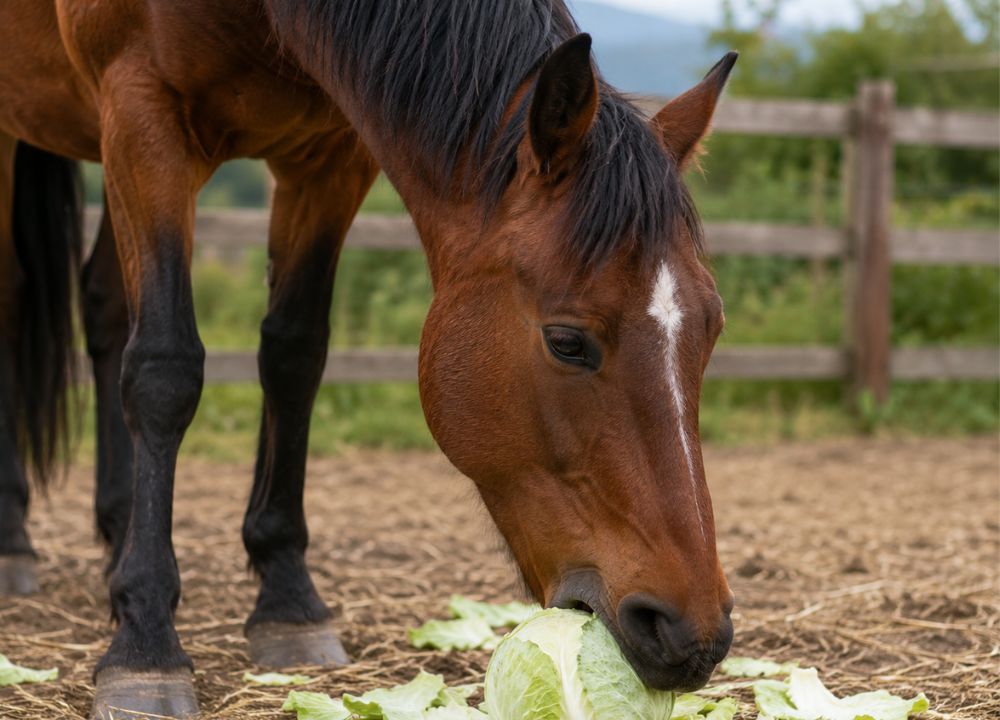
You spotted some fresh cabbage and thought it would make a nice treat for your horse. It looks healthy, it is green, and horses eat plants, so why not?
The problem is that horses have a very different digestive system from ours. Something that is perfectly healthy for humans can cause serious trouble inside a horse’s gut. If you feed the wrong food without knowing the risk, your horse could end up in real pain.
Colic is one of the most dangerous conditions a horse can face, and bad food choices are a common trigger. A horse in colic does not just feel discomfort; it can become life-threatening very fast if not treated by a vet.
According to Strathorn Farm Stables, the risk of feeding cabbage to horses clearly outweighs any reward, and there are much safer vegetables you can offer instead. Knowing this now can save your horse a lot of suffering.
Can Horses Eat Cabbage
Cabbage might look like a harmless leafy vegetable, but for horses, it is a different story. The compounds inside cabbage react badly with a horse’s digestive system.
Cabbage belongs to the cruciferous vegetable family, which is known for producing gas during digestion. Horses cannot burp or release gas the way humans can, so that gas gets trapped inside and causes real pain.
The sugar compound raffinose in cabbage builds up gas in the horse’s stomach, leading to bloating and serious discomfort. If that gas cannot escape, it causes a condition called colic, which stretches the gut wall and can become fatal.
Can Horses Eat Cabbage Leaves
Many horse owners think the leaves are the softer, safer part of the cabbage. But the leaves carry the same compounds as the rest of the vegetable.
Even a few cabbage leaves can start the gas-building process in a horse’s digestive tract. According to PangoVet, too much cabbage can result in gas-related colic, and overconsumption of cabbage leaves can lead to serious health problems, possibly even death.
It is better to keep cabbage leaves away completely rather than test how much your horse can handle. There is simply no safe amount that is worth the risk.
Can Horses Eat Raw Cabbage
Raw cabbage is the riskiest form because nothing has reduced its natural plant compounds before it enters your horse’s body. All the glucosinolates and raffinose are at full strength.
When a horse chews raw cabbage, those compounds start breaking down and releasing gases during digestion. This happens fast, and the effects can show up within hours of eating.
Can Horses Eat Fresh Cabbage
Fresh cabbage is just as risky as raw cabbage. In fact, the fresher it is, the more active its compounds are.
Horse owners sometimes think freshness means safety, but that is not the case here. Fresh cabbage delivers full-strength raffinose straight into a gut that has no way to handle the gas it creates.
Can Horses Eat Different Types of Cabbage
Some people wonder if switching the type of cabbage makes it safer. It seems logical, since different varieties have different nutrient profiles.
But all types of cabbage belong to the same cruciferous plant family. They all contain raffinose and glucosinolates, so the digestive risk stays the same regardless of color or variety.
Can Horses Eat Green Cabbage
Green cabbage is the most common variety and the one most likely to end up near a horse by accident. It is also the one most often mistakenly offered as a treat.
It causes the same gas buildup and colic risk as any other cabbage. Just because it is the most familiar does not make it the safest.
Can Horses Eat Red Cabbage
Red cabbage has more antioxidants and vitamins than green cabbage, which makes some people assume it is a healthier option for horses. But the extra nutrients do not cancel out the digestive danger.
Red cabbage also contains raffinose, which causes the same bloating and intestinal gas in horses as green cabbage. More vitamins does not mean more safety.
Can Horses Eat White Cabbage
White cabbage is mild and soft, and some people think that makes it easier for horses to digest. The texture is gentler, but what is inside is still the same.
White cabbage is still part of the cruciferous family and still triggers gas in the horse’s gut. No amount of softness changes what the compounds inside do.
Can Horses Eat Dried Cabbage
Drying a vegetable changes its texture, but it does not remove its harmful compounds. Some horse owners assume dehydration makes cabbage safer, which is a common mistake.
Dried cabbage still contains raffinose, and in some cases, it is more concentrated because the water is removed. It carries the same colic risk as fresh or raw cabbage.
Why Can’t Horses Eat Cabbage
The core reason comes down to how a horse’s digestive system is built. It works in one direction only, meaning gas cannot be released upward the way it can in humans.
When cabbage breaks down in the gut, it produces a significant amount of gas. That gas has nowhere to go, so it builds up, causes bloating, and stretches the intestinal walls, which is incredibly painful for the horse.
According to Petoa, this situation is known as colic, and it can be fatal if not addressed quickly. The safest choice is to remove any cabbage from areas your horse can reach and speak to your vet if your horse has already eaten some.
FAQs
Is cabbage toxic to horses?
Cabbage is not classified as toxic, but it is still dangerous. It causes gas and colic, which can be life-threatening for horses.
What if my horse ate a small piece of cabbage?
One small piece is unlikely to cause a crisis, but watch your horse closely. Look for signs of bloating, restlessness, or discomfort, and call your vet if anything seems off.
Are all types of cabbage equally bad for horses?
Yes. Green, red, white, and dried cabbage all contain the same compounds that cause gas and colic. No variety is safe enough to offer on a regular basis.
What can I feed my horse instead of cabbage?
Carrots, celery, lettuce, cucumber, and pumpkin are all safe options. These give your horse a healthy treat without the digestive risks.
Can horses eat any cruciferous vegetables?
It is best to avoid the whole cruciferous family, including broccoli, kale, and Brussels sprouts. They all produce gas in horses and carry a risk of colic.