

A baby cat has 26 teeth, but as it grows and matures, its mouth is designed to capture and control prey and cut flesh like scissors, so it has a total of 30 teeth, called its permanent teeth. If you also want to know the details of your adult cat’s teeth, then stay here.
Here in this content, I will go through scientific research about how many adult teeth cats have and whether adult cats lose their teeth or not, and everything that you need to know about your cat’s teeth.
The answer is so simple: adult cats have a total of 30 teeth. But what types of teeth they have and where they are located are what you have to understand in this content, so let’s get started.
How many milk teeth do adults have?
Biologically, a healthy and adult cat should not have any deciduous teeth in its mouth. Deciduous teeth are found only in kittens, and there are 26 in total.
Scientifically, these deciduous teeth are expressed by the following formula: 2 × (i 3/3, c 1/1, p 3/2) = 26. This formula does not include molars because kittens do not have molars. These deciduous teeth are thinner, sharper, and slightly more transparent than adult teeth.
A major medical problem arises when these deciduous teeth do not fall out on time, and permanent teeth begin to erupt beneath them. This condition is called “Retained Deciduous Teeth”, in which two teeth appear in the same place.
This double presence of teeth creates congestion in the mouth, which traps plaque and food particles and increases the risk of gum disease. That is why it is very important for veterinarians to distinguish between a cat’s baby teeth and permanent teeth.
For example, a baby third premolar can be very similar in shape to a permanent fourth premolar, while a lower jaw baby fourth premolar resembles a permanent first molar.
If a cat’s baby tooth does not fall out at the scheduled time, an X-ray is necessary to determine whether a permanent tooth is present beneath it. If a permanent tooth is present, the baby tooth may need to be surgically removed to prevent the problem.
How Many Adult Cats Have Incisor Teeth?
Adult cats have a total of 12 incisors, or front teeth, in their mouths. The distribution of these teeth is the same in both jaws; that is, 6 teeth are found in the upper jaw and 6 teeth in the lower jaw.
According to the international system of oral surgery and dental classification, called the “Modified Triadan System”, these teeth are given the numbers 01, 02, and 03 on the right and left sides of each jaw.
The front teeth of cats are very small, and their main function is not to chew food. Cats use these teeth to clean their hair, remove dirt and fleas from their bodies, etc., and pick up small objects in their mouths.
Since these teeth are very small and close together, they tend to accumulate plaque and dirt, which increases the risk of gingivitis. How
How Many Adult Cats Have Canine Teeth?
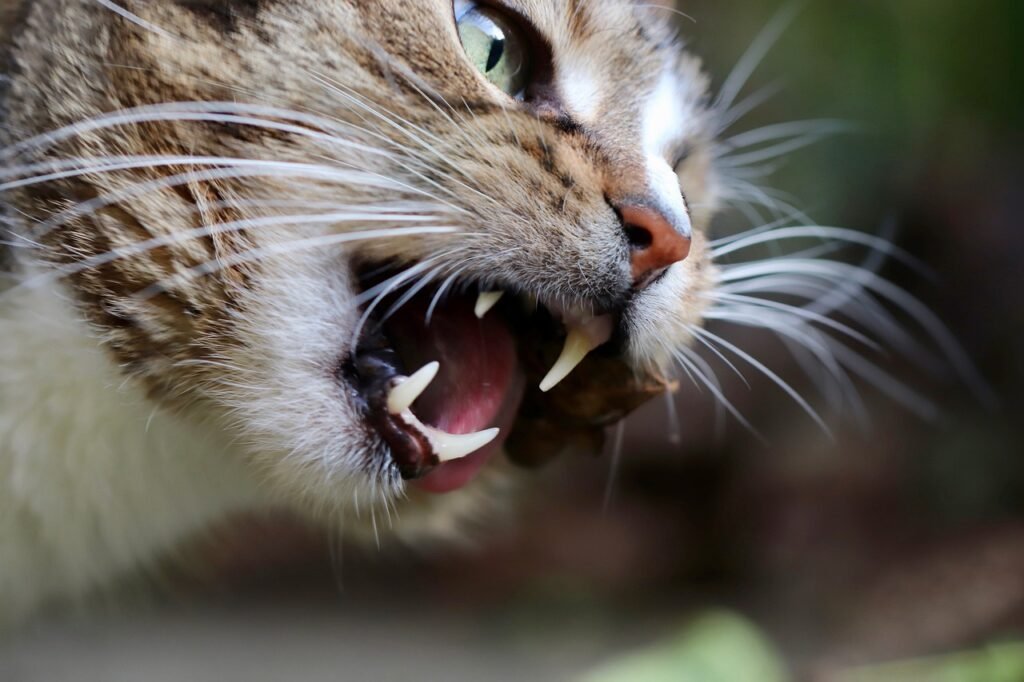
A healthy adult cat has 4 canine teeth. These teeth are located on both sides of the upper and lower jaws, one on each. Under the Trident system, they are always numbered 04; for example, the right upper canine tooth is called 104.
These teeth are the biggest sign that cats are predators; they are long, strong, and pointed. Their main function is to hold prey tightly, pierce its body, and tear flesh. The roots of the canine teeth go very deep into the jawbone, which also supports the facial structure.
If these teeth fall out due to an accident or illness or have to be extracted, it becomes difficult for the cat to grasp food and keep its mouth closed properly, which often causes the tongue to hang out of the mouth.
How Many Adult Cats Have Premolar Teeth?
Adult cats have a total of 10 premolars. The distribution of these teeth is not uniform across the jaws; the upper jaw has 6 premolars (3 on each side), while the lower jaw has only 4 premolars (2 on each side).
Compared to dogs, which have 16 premolars, cats have lost several teeth during their evolutionary history. According to the Triad system, cats lack the first premolar in all four segments, and the second premolar in the lower jaw is also missing.
Therefore, when counting the teeth in the lower jaw, the third premolar and fourth premolar are counted because the fourth and fifth teeth, directly after the canine, are missing. These teeth help cut and chew meat like a knife.
How Many Adult Cats Have Molar Teeth?
Adult cats have the fewest molars, only 4. These teeth are located at the very back of the mouth, and each molar is found in only one part. In the Trident system, molars are always numbered 09.
Cats have a severe lack of teeth compared to dogs; they lack the upper second molar and the lower second and third molars at the tip. Cats’ upper fourth premolar and lower first molar form the “carnassial system“, which acts like two blades of scissors to crush and cut hard bones and flesh fibers
Adult Cat Teeth Chart
The table below provides a comprehensive diagram for a correct understanding of the structure of teeth, their locations, and triad numbers, clearly indicating the presence of teeth in the cat’s jaw and the missing teeth compared to the dog’s jaw:
| Jaw Quadrant | Present Teeth | Missing Teeth | Total Teeth |
| Upper Right | 3 Incisors, 1 Canine, 3 Premolars, 1 Molar | First Premolar, Second Molar | 8 |
| Upper Left | 3 Incisors, 1 Canine, 3 Premolars, 1 Molar | First Premolar, Second Molar | 8 |
| Lower Left | 3 Incisors, 1 Canine, 2 Premolars, 1 Molar | First and Second Premolars, Second and Third Molars | 7 |
| Lower Right | 3 Incisors, 1 Canine, 2 Premolars, 1 Molar | First and Second Premolars, Second and Third Molars | 7 |
When Do Cats Get Their Adult Teeth?
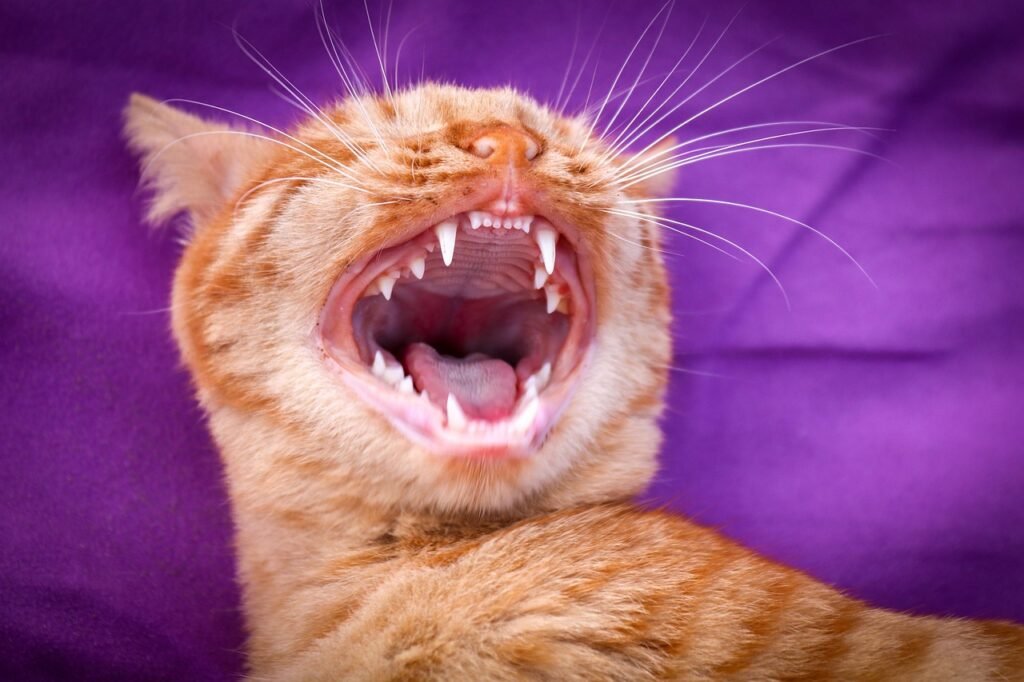
The shedding of baby teeth and their replacement by permanent adult teeth is a highly regulated and biological process in kittens. This period of tooth eruption reflects the kitten’s overall health and bone development.
During the transition period, kittens experience noticeable changes in behavior. They chew on household items more often, their gums may bleed slightly or ooze, and they may show reluctance to eat or drink.
Cats often swallow their broken baby teeth with their food, which is why owners often find a few teeth lying on the floor. According to veterinarians, regular medical check-ups for kittens between 6 and 18 weeks are essential so that any damaged or premature baby teeth can be treated promptly.
Do Adult Cats Lose Their Teeth?
Tooth loss in an adult cat is never considered a normal or natural part of aging but is always a sign of an underlying disease or injury.
In the home environment, if an adult cat loses a tooth, it means that the bones and gum tissue that attach the tooth to the jaw have been weakened and destroyed by severe infection or disease.
The leading cause of tooth loss in adult cats is periodontal disease (gum and tooth disease), in which plaque and tartar damage the bone and tissues that support the teeth.
The second leading cause is Tooth resorption, in which the body’s cells slowly destroy the root and internal structure of the tooth. In addition, diseases such as dental congestion, diabetes, feline leukemia, feline AIDS, and calicivirus can also cause teeth to weaken and fall out.