
Have you ever looked into your cat’s mouth and wondered why its front teeth are so small? Perhaps you’ve noticed while playing, yawning, or brushing its teeth that its front teeth look almost like tiny grains.
Many cat owners are even confused when they see them for the first time and wonder if the teeth are broken, not growing properly, or if their cat is still a kitten.
Interestingly, not all cat teeth are the same. Its long and pointed fangs are immediately visible, but the front incisors are naturally very small. This is why many owners consider the size of these teeth to be abnormal, although in most cases it is completely normal.
I am going to tell you which cat teeth are really small, what are the possible reasons for their small appearance, and why these teeth are so different from those of dogs or humans.
You will also know whether or not small teeth indicate a problem, what their actual function is, and how you can tell if your cat is still a kitten or a full-grown cat just by looking at their teeth.
Which Cat Teeth Are Actually Small?
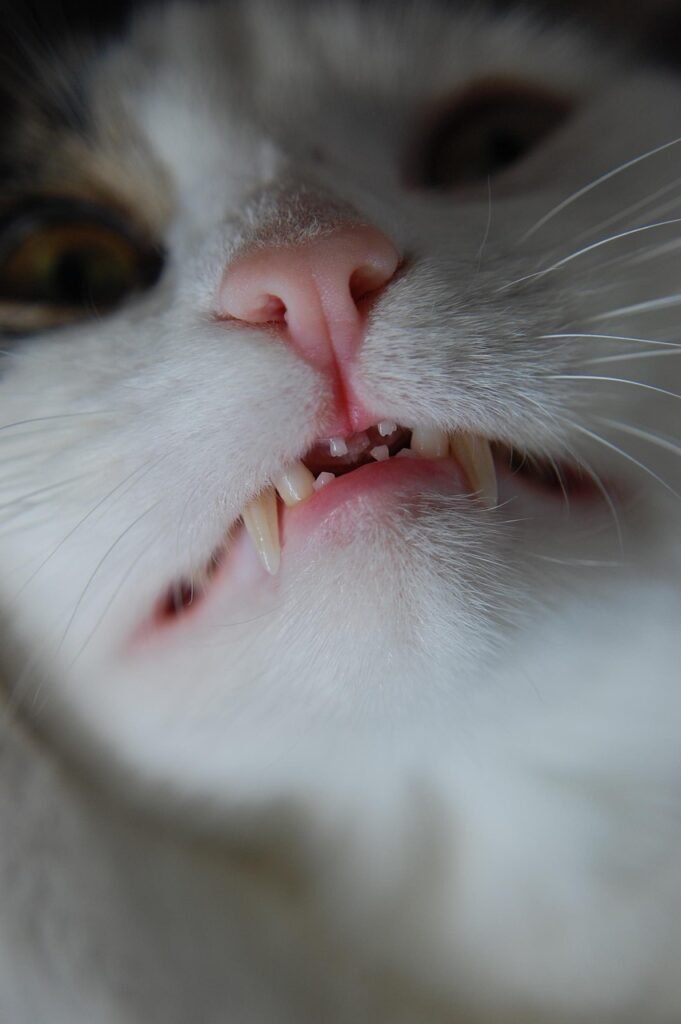
The 12 incisors that are at the front of a cat’s mouth are the smallest and thinnest of all the teeth. “Cats have very small incisors,” says the Dorval Dental Clinic.
That’s a total of six in the upper jaw and six in the lower jaw, and they’re usually very thin. In contrast, cats’ long canines (fangs) are very large and sharp, and their premolars are also relatively thick and wedge-shaped for biting prey.
Why Are My Cats Front Teeth So Small?
Grooming:
The main function of these small teeth is to clean the cat’s fur. According to Pet Medical Center, a cat’s incisors are used to remove debris and scrape away hair. Similarly, according to the VCA report, these teeth are more useful for self-cleaning and cutting small pieces of wet grass than for hunting.
Feeding habits:
Cats are obligate carnivores, so their teeth are designed only for tearing meat. According to Express Vets, cat teeth are only “made for tearing meat”; they are not for grinding. The Dorval Clinic also states that carnivores do not need “chewing” teeth, they are made of “weapons” in their mouths, not large wet teeth.
Jaw movement, Number and size of teeth:
A cat’s jaw only moves up and down. Therefore, it does not need large, wide molars and molars like humans or herbivores.
Humans, dogs, and cats have different numbers of teeth. An adult human has 32 teeth, a dog has 42 teeth, and a cat has only 30 teeth.
Also, humans and some dogs eat a more varied diet, which requires larger and wider teeth. Cats have fewer and smaller teeth that are naturally smaller in size so that they can tear flesh quickly and efficiently.
Why Do Cats Have Small Teeth Compared to Dogs, or Humans?
Cats have smaller teeth than dogs or humans because their diet and body structure are different. Just as an adult dog typically has 42 teeth and an adult cat only has 30, humans have 32 teeth.
Dogs and humans have more diverse and chewing teeth because their diet includes both vegetables and hard foods. In contrast, a cat’s entire system is designed to eat only meat, so its teeth remain small and sharp.
Compared to humans and omnivores, cats have developed “biting” tools in their mouths rather than “chewing” them, says the Dorval Clinic. What’s more, a cat’s jaw only moves up and down, so it doesn’t need the large, grinding molars that humans and dogs have.
Is it Normal to Have These Small Teeth?
Yes, it is perfectly normal to have these small teeth. An adult cat usually has 30 (sometimes even 32) teeth in their mouth, including 12 very fine incisors. Incisor teeth are essential for a cat and their normal presence is a sign of good health.
According to the VCA, these small teeth help to collect hair and properly cut small pieces of food. If a cat’s front teeth are in the right place and in good condition, this is not a sign of illness, but rather a completely normal condition.
What is the Role of Small Teeth of Cats?
The main function of these teeth is to help the cat with cleaning and fine tasks. According to research by Pet Medical Center, a cat’s small incisors help “grab small pieces of food and keep itself clean from the mouth.” PetMD also states that these teeth are not used directly for hunting, but are useful for “scratching hair and picking up objects.” According to VCA, a cat can use these teeth to cut grass or cut its nails. In this way, these small teeth act like tiny pincers or nipples for the cat, which are capable of grasping very sensitive and delicate objects.
Small Teeth in Kitten and Adult Cats? Is this is Difference, Best Part
There is a difference between the teeth of a kitten and the teeth of an adult cat. When a kitten is born, its first milk teeth begin to appear in the first two to three weeks.
By the age of six to eight weeks, 26 milk teeth, including incisors, appear in its mouth. These teeth are very small, pointed, and delicate.
Then, by the age of three to six months, these milk teeth fall out and permanent teeth appear, and by the age of about 6 to 7 months, the cat has a total of 30 permanent teeth in its mouth.
The surprising thing is that when your cat’s front teeth are very thin and small, it is usually still in the kitten stage. That is, by looking at these small teeth, you can understand that your cat is still a baby.
Once the permanent teeth appear, these teeth become slightly larger and stronger, but the cat’s mouth always remains smaller than other animals.