
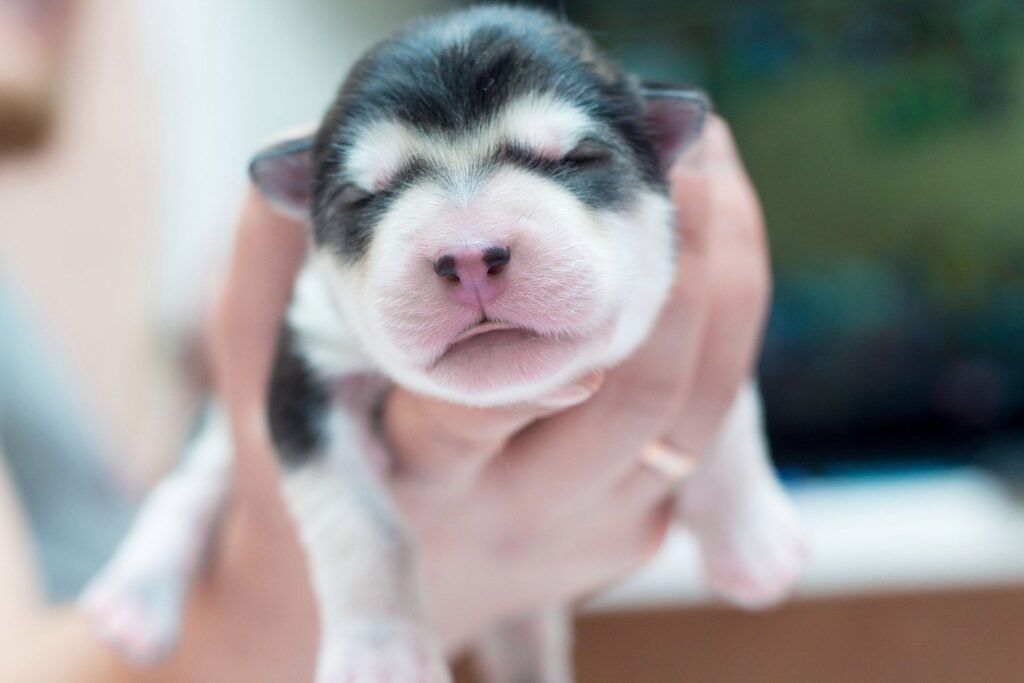
Baby dog teeth play an important role in the early development of puppies. These temporary teeth not only help with chewing and gripping food but also support proper jaw development and make room for the permanent teeth in the future.
Like cats, dogs have two distinct sets of teeth during their lives, known scientifically as the deciduous and permanent dentitions. This process reflects a profound, integrated balance among the animal’s skull anatomy, feeding habits, and evolutionary survival.
Puppies usually have 28 baby teeth, including incisors, canines, and premolars, with molars not yet present at this stage. These teeth begin to erupt in the first few weeks of life and fall out naturally over time, to be replaced by permanent teeth.
How many milk teeth do dogs have?
Puppies have a total of 28 temporary or primary teeth. These teeth are not visible at birth but are protected within the gums, as newborns are completely dependent on their mother’s milk, and the presence of teeth can damage the mother’s nipples.
When puppies are about three to four weeks old, these teeth begin to erupt through the gums, and by eight weeks of age, all 28 temporary teeth are fully erupted. Adult dogs have a total of 42 larger permanent teeth, deeper roots, and wider teeth than primary teeth.
The structure of the primary teeth is very specific: they are much smaller, thinner, and more pointed than the permanent teeth, which is why they are often called “needle teeth”. This sharpness allows puppies to bite through hard or semi-solid food early on, despite their weak jaws.
| Feature | Puppy Teeth (Temporary Teeth) | Adult Teeth (Permanent Teeth) |
| Total Number of Teeth | 28 | 42 |
| Upper Jaw Teeth | 14 | 20 |
| Lower Jaw Teeth | 14 | 22 |
| General Appearance | Small, thin, and needle-like | Larger, broader, and stronger with well-developed roots |
| Time of Eruption | 3–8 weeks of age | 3–8 months of age |
Types of a Dog’s Baby Teeth
Baby dog teeth are classified into three main groups based on their shape, anatomical position, and specific function. Each type of tooth is located in a different part of the mouth and plays an important role in helping puppies efficiently grasp, tear, and chew food.
Deciduous Incisors
Deciduous incisors are the small, straight teeth located at the very front of the mouth. Puppies have a total of 12 incisors, with 6 in the upper jaw and 6 in the lower jaw.
Their primary functions include scraping, picking up objects, gentle biting, and grooming. These teeth are usually the first baby teeth to loosen and fall out during teething, as permanent incisors replace them.
Deciduous Canines
Located immediately beside the incisors, deciduous canines are the long, pointed, slightly backward-curving teeth commonly known as fangs. Puppies have 4 deciduous canines in total, with 2 in the upper jaw and 2 in the lower jaw.
These teeth are designed for gripping, piercing, tearing, and securely holding food or objects. Beyond their feeding function, deciduous canines also play an important role in a puppy’s social development.
During play with littermates, they help puppies learn bite inhibition, the ability to control the force of their bite. If a puppy bites too hard, its playmates’ reactions teach it to moderate its biting pressure, an essential behavior for healthy social interaction.
Deciduous Premolars
Deciduous premolars are located behind the canines toward the back of the mouth. Puppies have 12 deciduous premolars, with 6 in each jaw.
These teeth have relatively broad, sloping chewing surfaces that function like scissors, allowing puppies to cut and break food into smaller pieces before swallowing. Unlike adult dogs, puppies do not have first deciduous premolars. As a result, the baby premolars begin with the second premolar, making this a unique feature of the deciduous dentition.
Why Do Baby Dogs Don’t Have Molar Teeth?

The absence of molars in puppies is not a coincidence but rather the result of complex evolutionary, anatomical, and physiological needs.
The basic biological reasons for this are based on the following scientific foundations: Anatomical limitations and jaw size. At birth and during the first two months after birth, the puppy’s jaw (mandible and maxilla) is still in the early stages of development and is very small.
The permanent molars are very wide, heavy, and deeply rooted. The puppy’s small skull and delicate jawbone do not have enough space to accommodate these large, heavy molars.
As the dog grows and its jawbone expands in length and width, the back of the skull provides sufficient space for these large molars. Feeding habits and energy balance: Weaned puppies, or those recently transitioned from mother’s milk to a soft diet, do not need to grind hard foods, such as bones or tough fibers.
The main function of the molars is to crush bones and grind hard foods. Since the initial diet of puppies is very soft and easily digestible, their bodies do not need to waste their biological energy on building and maintaining molars.
Evolutionary substitution and the principle of diphyodonty. Most vertebrates (such as fish and reptiles) are polyphyodont, meaning they replace their teeth repeatedly throughout their lives.
In contrast, dogs and most mammals are diphyodont, meaning they replace their entire set of teeth only once in their lifetime. Precise occlusion of the upper and lower teeth is essential for efficient chewing in mammals.
If the molars erupt in the puppy’s growing jaw from infancy, the lengthening of the jawbone will cause the teeth to misalign, and the dog will lose the ability to chew as an adult. Therefore, the molars erupt as permanent teeth only when the jaw has reached its final stages of development.
When Do a Dog’s Baby Teeth Come In?
The eruption and subsequent loss of baby teeth in dogs follow a highly coordinated, genetically determined timetable. Although there are slight genetic differences depending on the breed, the timeline of a typical and healthy puppy consists of the following stages:
2 weeks from birth: At this stage, the puppy’s mouth is completely devoid of teeth, and the gums are soft, suitable for sucking milk.
3 to 4 weeks: The first temporary teeth (canines) begin to emerge from the gums, giving rise to the initial ability to bite.
4 to 6 weeks: The front temporary teeth (incisors) and back temporary teeth (premolars) emerge from the gums one after the other.
8 weeks: By the eighth week, all 28 temporary teeth have fully taken their positions inside the mouth, and this is when the puppies are usually able to move to their new homes.
12 to 16 weeks: The transitional phase of baby teeth loss and permanent teeth eruption begins, where the baby teeth begin to fall out first.
4 to 7 months: During this time, all temporary teeth fall out one by one. And in their place, permanent incisors, canines, premolars, and new molars erupt. By the seventh to eighth month, the dog has a full set of 42 permanent teeth.
The Small Dog Delay in Small and Toy Breed Dogs. Modern veterinary research has shown that the eruption and loss of teeth in small, lightweight dogs (especially those weighing 3 kg or less, such as Yorkshire Terriers, Maltese, and Chihuahuas) are significantly delayed.
The eruption of permanent teeth in these small dogs is slower than in larger dogs, which is why they are more likely to have problems with teeth getting stuck in the gums or falling out late.
| Age of Dog | Dental Changes | Clinical Significance / Biological Changes |
| 0–2 Weeks | No teeth are present. | Newborn stage; puppy depends entirely on mother’s milk. |
| 3–4 Weeks | Deciduous (puppy) canines begin to erupt. | Transition to solid food begins; chewing behavior starts. |
| 5–8 Weeks | All 28 puppy teeth have erupted. | Weaning is complete; puppies can chew solid food. |
| 12–16 Weeks | Deciduous incisors begin to fall out. | Permanent dentition begins; mild gum bleeding may occur. |
| 4–6 Months | Permanent premolars and canines erupt. | Increased gum irritation and chewing behavior due to teething. |
| 5–7 Months | Permanent molars erupt. | Final stage of tooth eruption; dog chews using the back of the mouth. |
| 8 Months and Older | All 42 permanent teeth are fully erupted. | Adult dentition is complete; gum inflammation resolves. |
How Does a Baby Dog Feel When Teething?
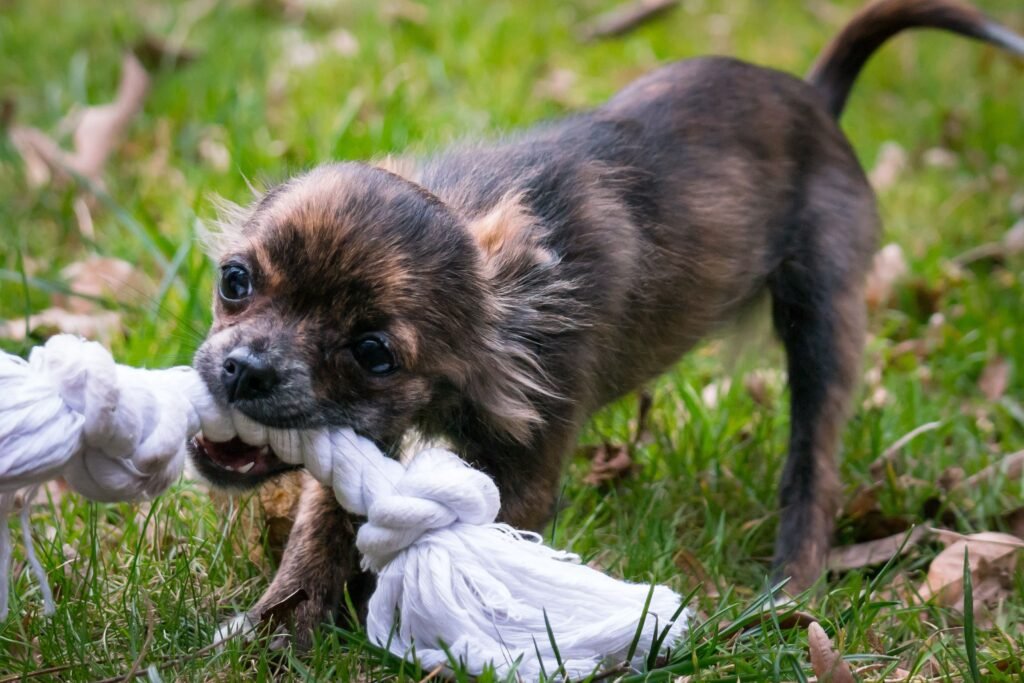
The eruption and replacement of teeth are extremely uncomfortable and sensitive stages for a puppy, both physically and neurologically. During this period, changes in the body and gums are reflected in a variety of behavioral and physical signs.
Severe Gum Itching, Pain, and the Urge to Chew
As the permanent tooth buds begin to develop beneath the gums, they exert pressure on the roots of the deciduous (baby) teeth. This pressure gradually causes the roots of the baby teeth to resorb (dissolve), leaving only the crowns behind, which eventually become loose and fall out. During this process of root resorption and gum erosion, the gums become inflamed, swollen, and red.
Because of this inflammation, pain, and intense itching, puppies develop a powerful and natural urge to chew (destructive chewing) to relieve the discomfort. They may constantly chew furniture, shoes, clothing, blankets, toys, and even their owners’ hands and feet, as the pressure temporarily soothes their painful gums.
Excessive Drooling and Bleeding Gums
Inflammation and movement of erupting teeth make the gums highly sensitive, which stimulates increased saliva production. As a result, puppies often drool much more than usual.
In addition, when baby teeth loosen and fall out, mild bleeding from the gums is completely normal. Owners may notice small bloodstains on chew toys, blankets, ropes, or bones, which are generally not a cause for concern.
Irritability, Reduced Appetite, and Mild Fever
During the peak teething period, puppies may become irritable, restless, or lethargic because of gum pain. They often whine or cry more than usual due to the discomfort.
Since chewing hard food becomes painful, many puppies temporarily eat less, chew more slowly, or refuse dry food altogether. The body’s inflammatory response during this developmental stage may also result in a mild low-grade fever.
Changes in Mouth Odor (Teething Halitosis)
Young puppies naturally have a pleasant, sweet-smelling breath known as “puppy breath,” largely due to their milk-based diet and the relatively low number of harmful oral bacteria.
However, during teething, this characteristic smell often changes into an unpleasant, metallic, or foul odor. This change is primarily caused by gingivitis (gum inflammation), minor bleeding from shedding baby teeth, and food particles becoming trapped between the erupting permanent teeth and the remaining baby teeth, where bacteria rapidly multiply.
Persistent Deciduous Teeth: A Genetic Risk
Sometimes a permanent tooth erupts beside, rather than directly beneath, its corresponding baby tooth. When this occurs, the root of the baby tooth fails to resorb properly, causing it to remain firmly in place. This condition is known as persistent deciduous teeth (retained baby teeth).
This problem is especially common in small and brachycephalic (short-faced) breeds such as Pugs, Bulldogs, Maltese, and Toy Poodles.
When both the baby tooth and the permanent tooth occupy the same space, overcrowding occurs. Food debris becomes trapped more easily, dental calculus (tartar) accumulates rapidly, and severe periodontal disease can develop at a very young age.
Dentigerous Cysts Caused by Impacted Teeth
If a permanent tooth is unable to erupt because it is trapped beneath the gum or jawbone (an impacted tooth), it can lead to serious complications. Approximately 50% of impacted teeth may develop fluid-filled sacs called dentigerous cysts.
Over time, these cysts can enlarge and gradually destroy the surrounding jawbone from within, significantly increasing the risk of jaw fractures and, in rare cases, the development of malignant tumors.
Veterinary Recommendation
To prevent these complications, veterinary dentists recommend that puppies undergo a thorough oral examination at around 6 to 7 months of age.
If retained baby teeth are present, they are usually surgically extracted while the puppy is already under general anesthesia for spaying or neutering.
Removing these retained teeth allows the permanent teeth to erupt into their correct positions, reducing the risk of future dental overcrowding, periodontal disease, and other oral health problems.