

If you also want to know how many teeth a dog has, let me tell you one thing: it depends on the dog’s life stage. But not completely!! The dog’s life stage depends on several factors. So what should you know as a pet owner? We are going to talk about exactly this topic.
By the way, a dog’s life depends on factors like breed, size or weight, genetics, diet, and overall health. The total number of basic life stages is four: puppyhood, adolescence, adulthood, and senior years.
But to understand how many teeth your dog has, it will go through only three stages: the puppy stage, the teething stage, and the adult stage. Because a dog’s tooth numbers only change during the puppyhood stage, like human babies, and then remain the same till the adult stage.
So, in this content, we are going to dig deeper into exactly how many teeth we have at each stage. At the end, you will know exactly about your dog’s teeth, whether you are a new pet owner with curiosity, or your dog is losing teeth, and you want to know about it, or maybe you want to estimate your dog’s life stage. This content will clear all your confusion.
How Many Teeth Does A Dog Have?
Before we dig deeper, I am going to give a quick idea about how many teeth a dog has. So basically, an adult dog usually has 42 permanent teeth, while puppies (young dogs) have 28 milk teeth. The number of teeth can depend on breed, hereditary defects (such as hypodontia), and dental health.
Baby teeth in puppies begin to erupt three to six weeks after birth and are complete in about six to eight weeks. When the puppy is about 3 to 4 months old, those baby teeth begin to fall out and are replaced by permanent teeth. By ages 6 to 7 months, all 42 permanent teeth have appeared.
Factors That Affect How Many Teeth a Dog Has

Understanding the factors behind any topic is the foundation of understanding it. An adult dog is expected to have 42 teeth. However, your dog may have fewer teeth than that.
There can be several reasons for this, such as tooth loss, dental disease, injury, or breed-related factors. Understanding these factors helps you better understand your dog’s situation and whether its tooth count is normal.
Genetics and Hereditary Reasons:
Some dog breeds are born with slightly more or fewer teeth than normal. For example, Kerry Blue Terriers may be missing some permanent premolars.
Also, dogs with small or short noses (brachycephalic breeds) can have crooked or poorly aligned teeth because their mouths are narrow.
According to Merck Veterinary Manual, hyperdontia means having extra teeth, and it is seen in about 7.6% of dogs. Hypodontia means missing some teeth, and it is common in some breeds.
Extra or missing teeth:
Extra teeth can make the mouth crowded and may cause problems while eating. Missing teeth can change the position of nearby teeth, but they usually do not affect a dog’s ability to chew food.
Health and well-being
Dental disease, such as gum infection (periodontal disease), or broken teeth from an accident, can reduce the number of teeth in dogs.
If an adult dog has fewer than 42 teeth, it is usually because some teeth are broken or have been removed.
Remaining baby teeth:
Sometimes a puppy’s baby teeth do not fall out properly, which can block the growth of permanent teeth. This problem is more common in small breeds like toy poodles.
In such cases, a veterinarian may remove the baby teeth so the permanent teeth can grow in the right position.
How Many Teeth Does A Dog Have? From Baby to Adult Stage
It is something many pet owners ignore. You should know how many teeth a dog has at different stages of life. A puppy has fewer teeth than an adult dog.
As the dog grows, the number of teeth changes until it reaches adulthood. After that, the number usually stays the same.
How Many Teeth Does A Dog Have in the Puppy Stage?
A puppy (small dog) usually has 28 baby teeth. It includes about 12 incisors (small front teeth), 4 canines (pointed canines), and 12 premolars.
Puppies start to teethe after three weeks of age, and usually all 28 baby teeth have erupted by six weeks of age.
If a puppy’s teeth do not erupt completely within the prescribed time frame (6 to 8 weeks) or are missing, they are often extracted by their parents or a vet to help the permanent teeth come into their proper place.
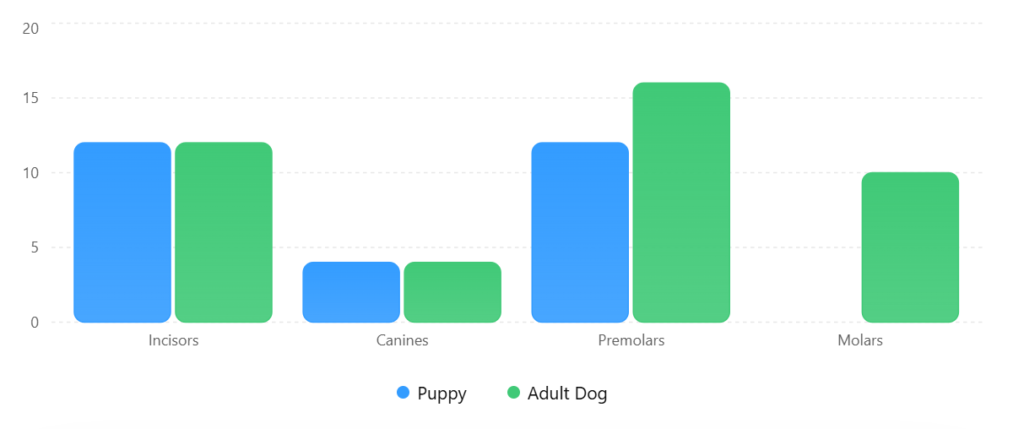
Below is a comparison of the number of teeth in puppies and adult dogs:
| Type (Teeth Type) | Number in Puppies | Number in Adults |
| Incisors (front small teeth) | 12 | 12 |
| Canines | 4 | 4 |
| Premolars | 12 | 16 |
| Molars | 0 | 10 |
| Total | 28 | 42 |
The image above of a puppy’s and an adult dog’s mouths shows the arrangement of teeth. It compares the puppy’s mouth (28 teeth) on the left and the adult’s mouth (42 teeth) on the right.
The left image contains incisors, canines, and premolars, while the right image contains more molars, as shown in the table.
How Many Teeth Does A Dog Have in the Teething Stage?
The teething phase in puppies usually begins around 3 to 4 months, or 12 to 16 weeks, after birth. During this time, the puppy’s baby teeth fall out and are replaced by permanent teeth.
The first permanent incisors usually begin to erupt at 3 to 4 months of age, and the permanent canines and premolars appear by five to six months of age. By seven to eight months of age, the puppy has a full set of 42 permanent teeth.
During this teething phase, the puppy may experience mild discomfort, which usually leads to excessive chewing, mouth-smashing, or rubbing against a towel.
Some dogs may drool or have slight bleeding from the mouth during this time, and the mouth may have a bad odor due to inflammation of the teeth.
Owners should provide the puppy with soft, safe chew toys. Avoid objects such as heavy bones, hard sticks, or ice, as they can break teeth.
If a puppy’s tooth does not fall out in the prescribed time or if a baby tooth is left behind when the permanent tooth erupts, a veterinarian should be contacted to have it extracted.
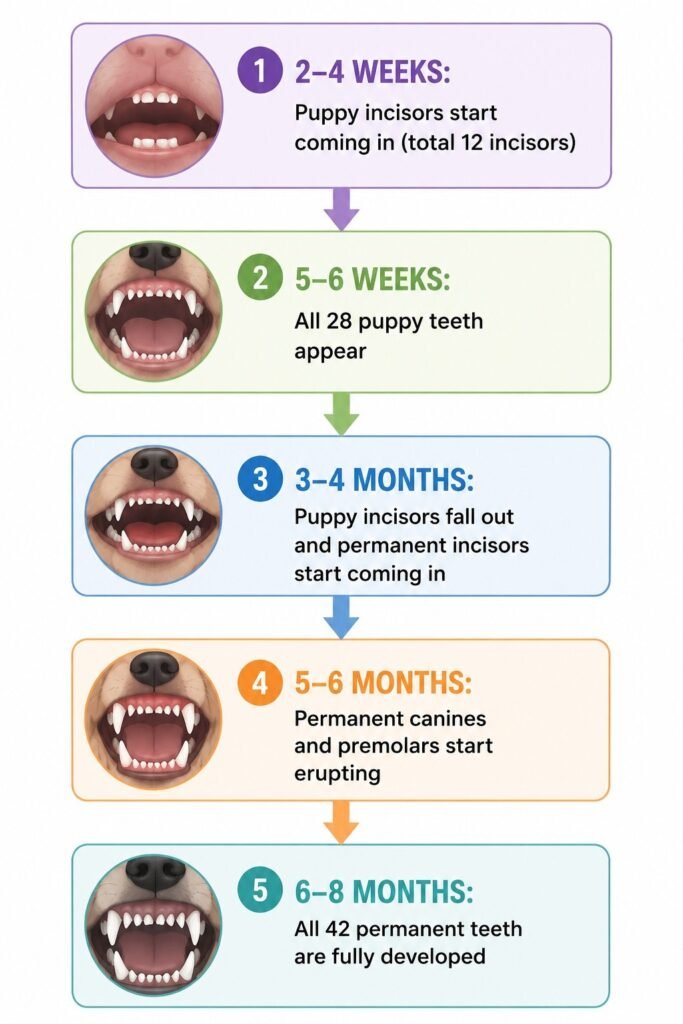
The flowchart above shows the main stages of the teething process. First, the puppy’s incisors appear, then the other baby teeth, and finally, all the permanent canine teeth come in.
How Many Teeth Does A Dog Have in the Adult Stage?
An adult dog usually has 42 permanent teeth. However, this number can be reduced if teeth are broken or extracted.
In adulthood, the permanent incisors erupt first, followed by the canines and premolars, and finally the molars. By six to eight months of age, all 42 permanent teeth have erupted.
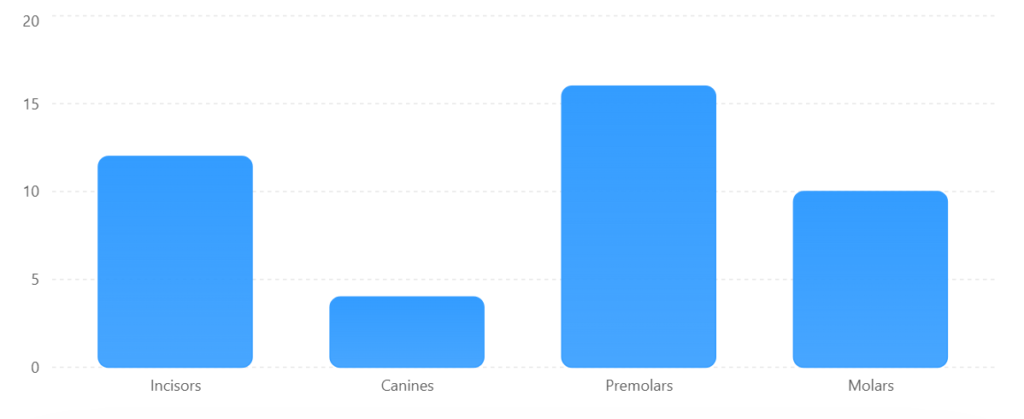
The diagram of adult dog teeth (above) shows their distribution. An adult dog has four basic types of teeth in its mouth:
- Incisors (small front teeth): 12 teeth in total, used for cutting small objects and cleaning the dog’s teeth & mouth.
- Canines (pointed canines): 4 teeth in total, best for gripping and tearing meat.
- Premolars (middle teeth): 16 teeth in total, used to cut and break down food into small pieces.
- Molars (large back teeth): 10 teeth in total, used to grind and crush hard food.
Dental Care and Health Problems of Your Dog
The average adult has 32 teeth, and puppies have 28; proper dental care is important for their long-term health.
With the following information, you can take care of your dog’s dental health and address any problems promptly.
Periodontal disease (gum infection) is very common in dogs. About 80% of dogs will develop periodontal disease by the age of three.
The disease manifests as tartar, plaque, and gum inflammation and, if left untreated, can lead to loose teeth. Good dental care includes daily teeth brushing, special dental chews or treats, and a balanced diet.
Common dental problems include tooth decay, which is usually caused by chewing on hard objects. If a tooth breaks, bleeds, or has bad breath, contact your veterinarian immediately.
Additionally, if a puppy’s baby teeth are not lost on time, such as a canine, permanent teeth may erupt haphazardly.
In such cases, the remaining baby teeth should be extracted after consulting a veterinarian.
If dogs have missing or extra teeth, it usually doesn’t have a major impact on their health, but it can affect their dental alignment.