

Cats’ dietary habits and meal times are essential for their overall health, longevity, and metabolic balance. Being obligate carnivores, cats’ digestive systems are designed to eat several small meals throughout the day rather than one large meal.
Choosing wet food not only provides cats with essential protein but also meets their hydration needs, as it has a much higher moisture content than dry food.
Many owners hesitate about how often to feed their cats wet food, but the decision should not be based solely on convenience; it should reflect the cat’s biological needs.
Determining the right feeding routine can not only prevent problems such as obesity, diabetes, and urinary tract diseases but also positively impact the cat’s behavior.
4 Factors That Decide How Often I Should Feed My Cat Wet Food
Your Cat’s Age
A cat’s age is the first and most important factor in determining its nutritional needs. Kittens have a very high metabolic rate in the early stages of their development.
In the first few months of life, they need to eat 4 to 6 times a day to meet their energy needs. At this age, their stomachs are very small, so they cannot eat large amounts at once.
As the cat reaches between 6 months and a year old, its meal times can be gradually reduced. In adult cats, body weight and muscle mass stabilize, so feeding them twice a day is sufficient.
However, senior cats, who are over 10 or 12 years old, require renewed attention. Cats may have weaker digestion or difficulty chewing as they age, which is why it is better to feed them in smaller portions (more frequent meals) rather than giving them a large meal at once.
Daily Calories Routine
The frequency of feeding a cat depends on its total daily caloric intake. An adult cat needs an average of 200 to 250 calories; however, this can vary depending on weight and breed.
When choosing wet food, you need to take into account the calories per unit on the can. If you want to provide 200 calories a day, you can divide it into 2 portions (100-100 calories), or, if the cat has digestive problems, into 4 portions (50-50 calories).
It is important to know that wet food has a lower calorie density than dry food, so it is normal for it to appear larger in quantity.
If you also give your cat treats, it is important to include them in your cat’s total daily calories to avoid excess calories.
The Resting Energy Requirement (RER) formula (RER = 70 × (Body Weight in kg)^0.75) is widely used by veterinary nutritionists to estimate a cat’s baseline daily calorie requirements.
Health condition
The cat’s health is the most important factor influencing feeding times. Cats with diabetes mellitus require a balance between insulin and food.
For them, doctors often recommend a fixed schedule of 2 to 3 times to keep blood glucose levels stable. Similarly, cats with chronic kidney disease often need wet food to stay hydrated, and feeding them frequently rather than large meals at once can help reduce the burden on their kidneys.
If the cat has digestive disorders or inflammatory bowel disease (IBD), feeding too much food at once can increase the risk of vomiting or diarrhea; in such cases, feeding small amounts frequently (Frequent, Small Meals) is the only solution.
In medical conditions, feeding times and frequency should be determined not only by your own convenience but also by veterinary advice.
Activity level and body weight
A cat’s activity level is directly related to its energy expenditure. A cat that is active all day, playing and hunting, needs more calories than a sedentary or indoor cat.
If you feed an active cat only once a day, it will get hungry very quickly, and its metabolism may be affected. Conversely, cats that only sleep are more likely to become obese.
Portion Control and Scheduled Feeding are essential to controlling their weight. If your cat has a high Body Condition Score (BCS), you should slightly reduce the amount of wet food per meal while keeping the feeding frequency the same.
To control weight, “Free-feeding” (i.e., leaving food out all day) should be avoided, as it can cause cats to overeat and gain weight.
How to combine this factor to know how often I should feed my cat wet food?
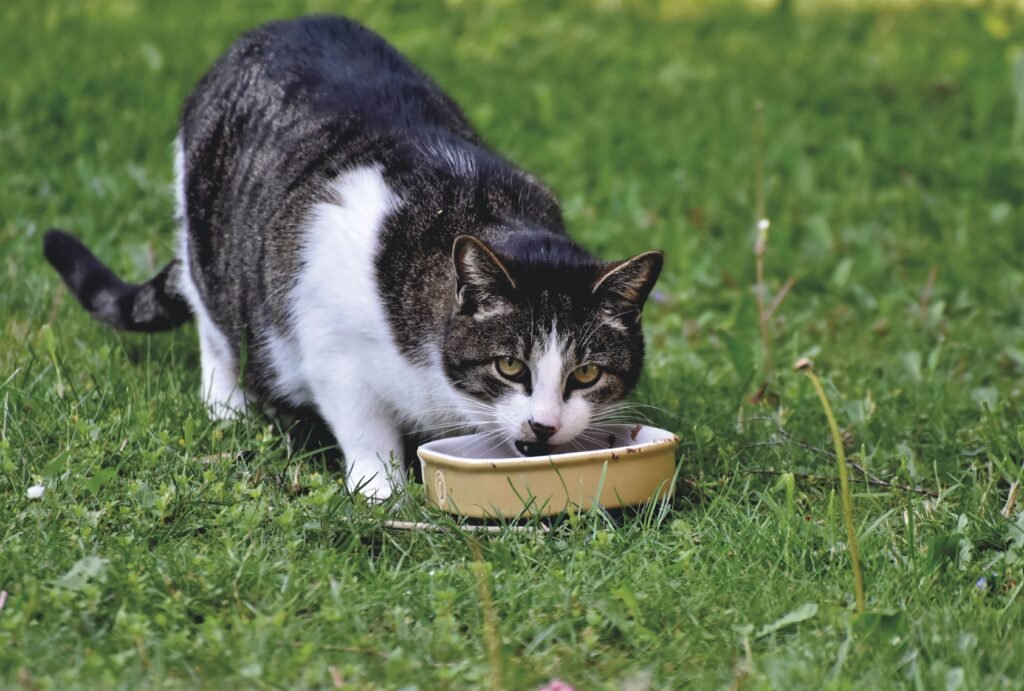
To put all these factors together and create a coherent system, you first need to create a “Baseline” for your cat. This baseline is a combination of his age, current weight, and medical needs as determined by the vet.
Once you have determined how many calories he needs throughout the day, the next step is to divide them into appropriate times.
For example, if your cat needs 200 calories a day, dividing them into 3-4 small meals rather than 2 large meals is often more satisfying for cats because it aligns with their predatory nature, in which they hunt small prey.
You also need to check whether your schedule is compatible with these times. If you are not home during the day, you can use Automatic Feeders (specifically designed for Wet Food and equipped with a cooling system).
Step by step
- Calculate Daily Caloric Requirement: Determine your cat’s daily calorie requirement based on their weight and age (with the help of a veterinarian).
- Determine Meal Frequency: Determine how often to feed your cat based on their activity level. 2 meals for a normal adult cat, 3 to 4 meals for a kitten or a cat with medical conditions.
- Split Portions: Divide the total daily calories over these times. For example, if feeding twice a day, 50% in the morning and 50% in the evening.
- Monitor Body Weight: Check your cat’s weight every 2 weeks. If they are gaining weight, reduce the amount by 5%-10%.
- Observe Behavior: If your cat seems to be begging between feedings, consider increasing the frequency without increasing the amount of food.
- Consistency: Once you have a schedule, don’t change it. Cats are routine animals, and a set schedule reduces their stress.
General Schedule & Feeding Table
The table below is a standard guide; however, you should consult your vet before making any changes.
| Cat’s Life Stage / Condition | Recommended Feeding Frequency | Feeding Strategy |
| Kitten (2–6 Months) | 4–6 times daily | Feed small, nutrient-dense portions to support rapid growth. |
| Kitten (6–12 Months) | 3–4 times daily | Gradually transition to fewer, larger meals while meeting growth needs. |
| Adult (Healthy/Inactive) | 2 times daily | Provide measured portions to maintain a healthy weight and prevent obesity. |
| Adult (Active/Working) | 2–3 times daily | Offer higher-calorie meals to meet increased energy requirements. |
| Senior or Cats with Health Issues | 3–4 times daily | Feed small, easily digestible meals to support digestion and overall health. |
Important Note: Never leave wet food out at room temperature for long periods (more than 2 hours), as bacteria can grow. Always discard or refrigerate any leftovers after serving, but it is important to bring them to room temperature before serving again.